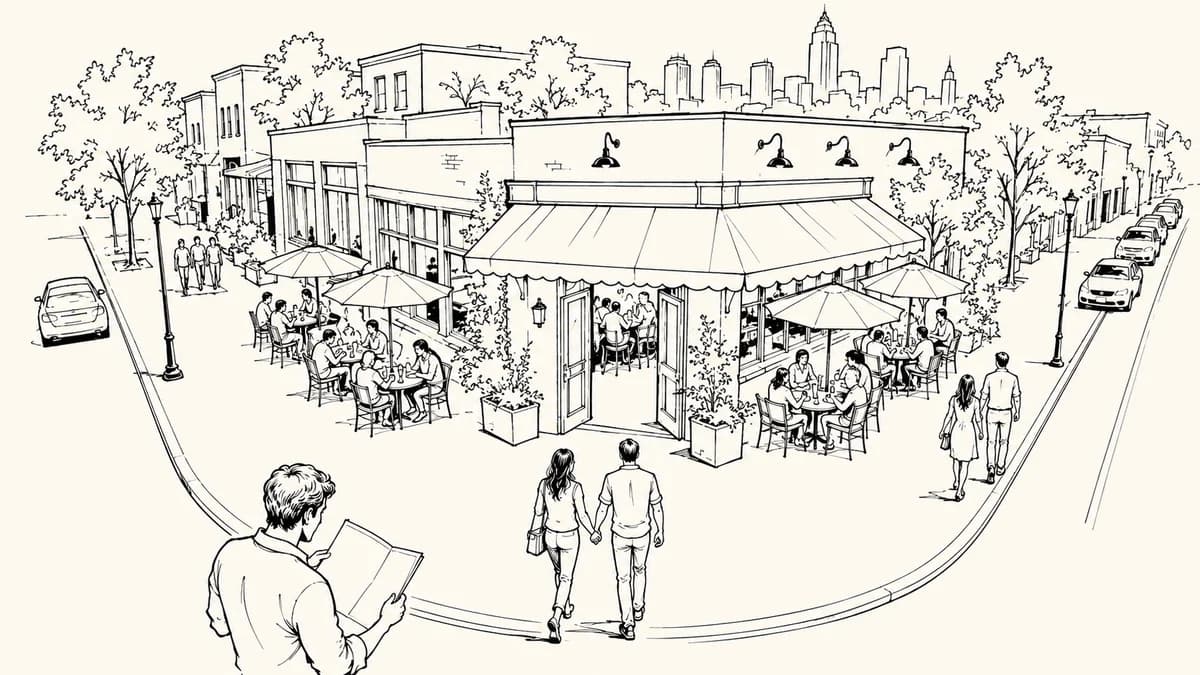
It's 6:40 on a Friday. Two people are standing on a sidewalk in NoDa, hungry, and one of them is already typing “tacos near me.” In the next ten seconds they will pick a place — from three results on a map, with photos, a star rating, and a wait time.
That moment is the whole game. Not your homepage. Not your follower count. Those three spots on the map.You're either one of them, or you're not in the conversation that decides your Friday covers.
Win the ten seconds where a hungry person is choosing. That's the whole game.
The map pack, not the website.
Search “brunch near me” and look at what fills the screen: a map and three businesses. That block — the map pack— is built almost entirely from your Google Business Profile, not your site. It's the most valuable real estate in local dining, and most independents leave it half-built.
Here's the good news for an operator: ranking there isn't a mystery, and it isn't pay-to-win. It rewards the places that keep their profile complete, current, and reviewed. That's blocking-and-tackling, not magic — which means you can actually win it.
What actually moves the needle.
Claim and finish the Google Business Profile
Not 80% done. Done. Right category (a taco shop is not a “restaurant,” it's a “Mexican restaurant”), every hour including holidays, the menu link, the order/reserve link, the phone that actually rings. Half-finished profiles lose to finished ones every time.
Real photos — the food and the room
Phone shots of the plate at the table, the dining room at 7pm, the line cook on the pass. Twenty good photos beats two stock ones. People eat with their eyes before they ever read a word.
Reviews, and replies to every one
Recency and volume both count. A steady drip of fresh reviews — and a short, human reply to each, even the bad ones — tells Google you're active and tells the diner you're paying attention.
NAP that matches everywhere
Name, address, phone — identical across Google, Yelp, Instagram, your site, the old directory you forgot about. Mismatched listings split your credibility and your ranking.
Posts and updates, not set-and-forget
A weekly special, a new menu item, the holiday hours. The profile is a channel, not a billboard. Operators who post show up more than operators who don't.
The regulars vouch. Strangers read it.
A diner trusts forty recent four-and-five-star reviews more than any line you'll ever write about yourself. The mechanics are simple and most kitchens skip them: ask at the table, ask on the receipt, ask in the follow-up — and reply to every review that lands, the warm ones and the cold ones both.
A short, human reply to a one-star (“That's not the night we want to run — email me and I'll make it right”) does more for the next reader than the complaint did against you. Quiet profiles look closed. Active ones look like a place worth the drive.
Four jobs only your website can do.
The menu that loads in one second
Half your traffic is a hungry person on a phone on the sidewalk. A PDF that pinch-zooms loses them. A clean, fast, mobile menu keeps them.
The structured data Maps reads
Restaurant, Menu, and opening-hours schema let Google pull your hours, price range, and dishes straight into the result. It's the difference between being listed and being featured.
The booking and order path
Reserve, order, join the waitlist — one tap, no dead ends. Maps gets them looking; the site is where the table actually gets booked.
The brand they remember
The room, the story, the regulars' favorites. The thing that turns a first-time “near me” tap into a Friday-night regular.
One clear brand beats one loud one.
Most independents don't lose because their food is worse. They lose because their presence is confusing— a Google photo from 2019, an Instagram in a different font, a website that looks like a third restaurant. The diner can't tell who you are, so they pick the place that made it obvious.
Standing out isn't shouting. It's one name, one look, one voice — on the map, on the feed, on the site — so the first impression and the third impression are the same restaurant. That consistency is what turns a “near me” tap into a name people actually remember.
We build the local stack.
You run the line.
We set up the whole thing so it works together: the Google Business Profile dialed in, a review engine that asks at the right moment, a fast mobile site with the menu and the schema Google reads, and the same brand running across all of it. You keep cooking. We keep you on the map.
The honest take.
You don't need a bigger marketing budget than the chain down the street. You need to win the ten seconds where a hungry person is choosing — and that's decided by a complete profile, fresh reviews, real photos, and a site that loads before they lose patience.
Do the unglamorous checklist, keep it current, and a neighborhood spot can out-rank a national one in its own zip code. That's the whole edge — and it's yours to take.